
|
The Nanonics MultiViewTM AFM-Raman Series:
Simultaneous AFM-Raman Imaging and TERS (Tip Enhanced Raman Spectroscopy)
|
|
|
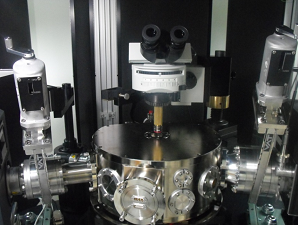
All Nanonics' MultiViewTM SPM series heads can be directly integrated with different Raman spectrometers. Shown on the left is the MultiView 4000TM two probe head mounted on the HORIBA Jobin Yvon Raman Spectrometer. The right-hand picture shows the MultiView1000TM head mounted on the Renishaw Raman Spectrometer.
|
Nanonics Imaging pioneered the field of AFM-Raman/TERS with the MultiViewTM series. Its hallmark free optical axis allows for seamless integration with any Raman system, whether upright or inverted.
Integration Packages are avilable for a variety of Raman manufactures including Renishaw PLC and HORIBA Jobin Yvon. These state-of-the-art integrations mark the beginning of a new era in high-resolution Raman spectroscopy.
Integration Package Solutions
The Integration Package is an optical connection package which can connect either to the Raman microscope or directly to the Raman spectrometer. The advantage is that the AFM sits on its own microscope which is completely isolated from vibrations from the Raman’s laser, spectrometer or CCD. This allows both the AFM and the Raman to work under ultimate conditions.
Three configurations for the Integration Package are available: Upright microscope; Inverted microscope or Dual microscope - a combination of an Upright and an Inverted microscope. The Nanonics MultiViewTM series is designed to be transparently optically integrated. The same head can work with either an Upright or an Inverted mircoscope and with a Dual microscope system where either backscattered or transmission operation is presented.
|
Left: Integration Package scheme of a Dual Microscope system with an efficient optical connection to external devices such as Raman spectrometers and Raman microscopes.
Right: MultiView 4000TM SPM system mounted on a Dual microscope and a vibration isolation platform of the Integration Package. The Integration Package contains an enclosure for acoustic shielding.
|
 |
 |
Integration Package with Established Spectrometers
Left: Integration package connected to the HORIBA Jobin Yvon iHR 550 Monochrometer
Right: Integration package connected to the Renishaw InVia Raman Microscope/Spectrometer
Back
AFM without Optical Obstruction
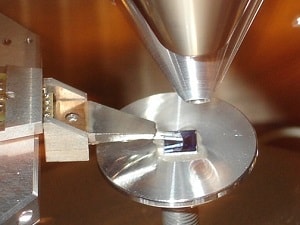
Nanonics' patented cantilevered optical fibers probes are held between the microscope lens and the sample without obstructing any aspect of the far-field optics and without any optical interference due to feedback. The tip in these fibers is exposed and illuminated by the lens of the microscope, allowing the user to view the exact region where the SPM and Raman information is collected.
Parallel Imaging
With the combined system, one can now record in parallel with Raman, a wide variety of scanned probe imaging modalities. For example, while the Si Raman peak of a microcircuit is being monitored to detect stress in the silicon, the Raman spectroscopist can simultaneously measure the circuit's micro-topography with AFM, as well as its NSOM reflectivity or its electrical properties, such as the dopant concentration.
In addition, Nanonics provides software that can display all these images at once for direct and simultaneous comparison and analysis.
 |
|
|
|
Parallel imaging of a Silicon Semiconductor
Left: 9 x 7 micron AFM image
Right: Raman intesity of the same region at 520nm/cm
|
High Resolution Raman Mapping with Z-feedback
Conventional Raman Mapping
There is a serious drawback to Raman Spectroscopy when studying non-smooth surfaces. As with all lens-based microscopy techniques, Raman suffers from the problem of out-of–focus light.
When a sample is scanned conventionally under the illuminating beam of a Raman microscope, the uneven sample surface will scan in and out of the focal plane. As a result the resolution of the Raman mapping is limited by the large area of the unfocussed beam on the sample.
In addition, the point spread function is significantly broader where there are contributions from the out-of-focus light. As a result the Raman spectra of non-flat surfaces can be very misleading, and tend to misrepresent the true information that could be gained by using Raman.
Raman Mapping with Z-Control
The problem of out-of focus light can be solved by using a Z-feedback mechanism. With this feedback in place the surface of the sample can be kept in the focal plane throughout the scan.
All the Nanonics MulitView AFM platforms have completely free optical axis. This makes them the ideal add on to any Raman system to provide the Z-control necessary for true high resolution Raman mapping.
Examples of the Power of Integrated Raman/AFM
The difference between Raman mapping with and without Z-control can be seen clearly in the examples below. Here the vibrational mode of diamond is represented:
The Vibrational Mode of Diamond at 1334cm-1
|

With Z control
|

With Z control
|
 |
The pair of images on the left shows the same area mapped with and without Z-control. The advantage of Z-control is made apparent by the differences between the two.
The image on the right is a collage of AFM topography and Raman intensity of the same sample at two different wavelengths. Note the differences in the intensity of the two images: The bright spots at the top of the image at 1334cm-1 are absent from the image at 1525cm-1.
No other Raman system has sufficient control of Z position to pick out these differences.
Nanoindentation Correlated with Material Properties
To illustrate the combination of the worlds of AFM and Raman spectroscopy, actual data has been obtained on the Si stress problem mentioned above. A 14 x 14 micron AFM height image of a nanoindentation in Si is shown here (figure a) with a line scan (figure b) through a region of this AFM image.
The points on the AFM cross section are points at which Raman microscope spectra were collected. As a result of the nanoindentation, it can be seen that the silicon has been displaced. The question is whether or not these regions correspond to different phases of the silicon that can be correlated with the AFM measurements.
Only Raman microprobe spectroscopy can give this information. The Raman spectra were obtained at the same time as the topography was being measured.
Local Stress of MEMs Devices
Raman spectroscopy is a very important technique for measuring silicon strain. On-line AFM can impose finely controlled and well-defined strain on silicon with pressures exceeding megapascals since the area of a probe tip is nanometric. NanoRaman technology is ideal for super-resolution silicon stress measurements in floating structures such as combs and forks.
The on-line AFM allows for defined forces to be imposed on a MEMs cantilever while the on-line Raman measures the shift in the silicon vibrational frequency and silicon strain at the cross (see below). No other AFM is capable of such a combination.
|

Position A
|
|

Position B
|
|

Position C
|
|

Position D
|
|

Position E
|
|
Raman Shift as a Function of Local Stress Location
|
Intermittent Contact Mode in Liquids
In addition, the Nanonics SPM/Raman systems can operate in intermittent contact mode even in liquids. Thus, the whole world of NSOM/SPM imaging of biological materials in physiological media can now be directly correlated with Raman spectra.
TERS
|